Your inner critic isn't telling the truth — she's reading old data
The inner critic feels like a verdict. The research says she's a reflex — a learned, protective voice repeating old data with high confidence. Here's what Neff, Gilbert, and Kross actually found, and what to do with her tomorrow morning that isn't 'silence her.'


The voice that wakes you at 5:47 a.m. with a list of yesterday's mistakes is not, despite how she sounds, the voice of clarity. She is fast, confident, and almost always wrong about what she is wrong about. She is also one of the most studied phenomena in clinical psychology, and the research on her is older and more useful than the version most apps will sell you. Here is what inner critic actually means in cognitive terms — and what to do tomorrow morning that isn't "silence her," because that has been measured, and it doesn't work.
A stable, learned pattern of automatic self-evaluative thoughts that arrive in a recognizable internal voice, carry more authority than the evidence behind them, and are usually trying — clumsily — to protect you from a danger that was real once and may no longer be. Treatable. Not deletable. Modifiable in tone.
What the inner critic actually is in cognitive terms
There is no region in the brain labelled inner critic. What clinicians mean by the term is a pattern: a cluster of automatic negative thoughts about the self that arrive faster than deliberate thinking, in a tone the listener recognizes, and that resist contradiction.
The most precise framing comes from Paul Gilbert, the British clinical psychologist who developed Compassion Focused Therapy. Gilbert's model places the inner critic inside the threat-protection system — the older, faster neural circuitry that scans for danger and primes the body to respond.Gilbert 2010 In this model, the critic is not a moral voice or a truth-teller. She is a security guard who learned a long time ago that being preemptively harsh about you reduces the chance you will be harshly judged by someone else. Her tone is the tone of someone who is trying to help, badly.
The second framing comes from Kristin Neff at the University of Texas. Neff's three-component model of self-compassion identifies self-judgment — the running critical commentary on one's own behaviour — as the opposite of self-kindness and one of the strongest predictors of poor psychological outcomes across studies.Neff 2003 Crucially, Neff's data show the critic is not a sign of high standards. People with low self-judgment scores set the same standards as people with high self-judgment scores. The difference is what happens when those standards are missed.
So: she is real, in the sense that a pattern is real. She is learned, in the sense that no infant is born with her. She is protective in origin, even when her current effect is the opposite. And she is modifiable, in the sense that the volume she speaks at is not fixed.

Why she is so confident — Gilbert's threat-protection account
The reason the critic sounds so certain — the reason a sentence like you should have known better arrives in your skull at full volume without quotation marks — is that the threat-protection system she rides on top of evolved to be faster than deliberation. Speed is the feature. Accuracy is, regrettably, optional.
Gilbert's clinical work over thirty years places this circuitry next to two other regulatory systems: the drive system (motivation, pursuit) and the soothing system (safeness, affiliation, rest). The inner critic, in this model, is what happens when the threat system has been chronically dominant — usually because, at some point in development, danger was real often enough that the system learned to default on.Gilbert 2009 She is not lying. She is reading from a script that was last updated when you were eleven.
This is also why arguing with her tends to fail. The threat system does not weigh evidence. It scans for danger. When you respond with that isn't true, she hears that as new danger, recalibrate, and turns the volume up. When you respond with thank you for trying to protect me, the picture changes — not because the words are magic, but because you have engaged the soothing system, which is the only system that can quiet the threat system on a neurological timescale.
The trap of trying to silence her
If the critic is so unhelpful, the obvious move is to make her stop. The literature has been telling us for almost forty years that the obvious move does not work.
In 1987, Daniel Wegner and colleagues ran the now-famous white bear studies. Participants asked not to think about a white bear thought about it more frequently than a control group, and continued to do so even after the suppression instruction was lifted.Wegner 1987 The same rebound effect has since been documented for emotionally loaded thoughts, intrusive thoughts in OCD, and self-critical thoughts in depression. Telling the inner critic to be quiet is a thought-suppression instruction. Her response is predictable.
There is a second, subtler trap that Neff's research surfaced. When women high in self-judgment were asked to be more positive about themselves, the directive itself was processed as another critical demand — you should also be better at not being so hard on yourself.Neff 2011 The critic, in other words, easily absorbs the self-improvement instruction and uses it as material. Stop being so critical of yourself becomes the next thing she is critical about.
The shape of the trap is consistent across the literature: any posture toward the inner critic that involves more pressure — louder, kinder-but-still-demanding, more motivated — tends to feed her. The only posture that reliably reduces her volume is one she cannot use as fuel: warmth that is not contingent on her stopping.
Translation, not suppression — what the research suggests instead
If silencing fails, what works? The convergent finding across Neff (self-compassion), Gilbert (CFT), Kross (self-distancing), and the broader IFS-informed therapy literature is something close to translation. You do not delete the critic. You hear what she is trying to protect you from, restate it in a voice that doesn't activate the threat system, and let the soothing system handle the rest.
This is not a metaphor. It maps onto specific techniques the research supports:
- Address yourself by name or in the second person. Kross's lab has shown across multiple studies that switching from I to you or to your own name reduces medial prefrontal cortex activation during emotional reflection — the same region implicated in chronic self-criticism.Kross et al. 2014 Maddie, this is hard, and you are doing it lands differently than I am struggling and I should be better.
- Use conditional, not declarative, framing. Joanne Wood's 2009 work on the limits of positive affirmations showed that declarative statements (I am loved) deepen rumination for low-self-esteem participants. Conditional phrasing (I am learning to, I am becoming) bypasses the dissonance.Wood 2009 The same principle holds for translating the critic.
- Thank the critic for the protective intent, then redirect. This is the move Gilbert's CFT and the Internal Family Systems literature (Schwartz) converge on independently. The acknowledgement engages the soothing system. The redirect — and I am safe enough now to choose differently — gives the threat system permission to stand down.
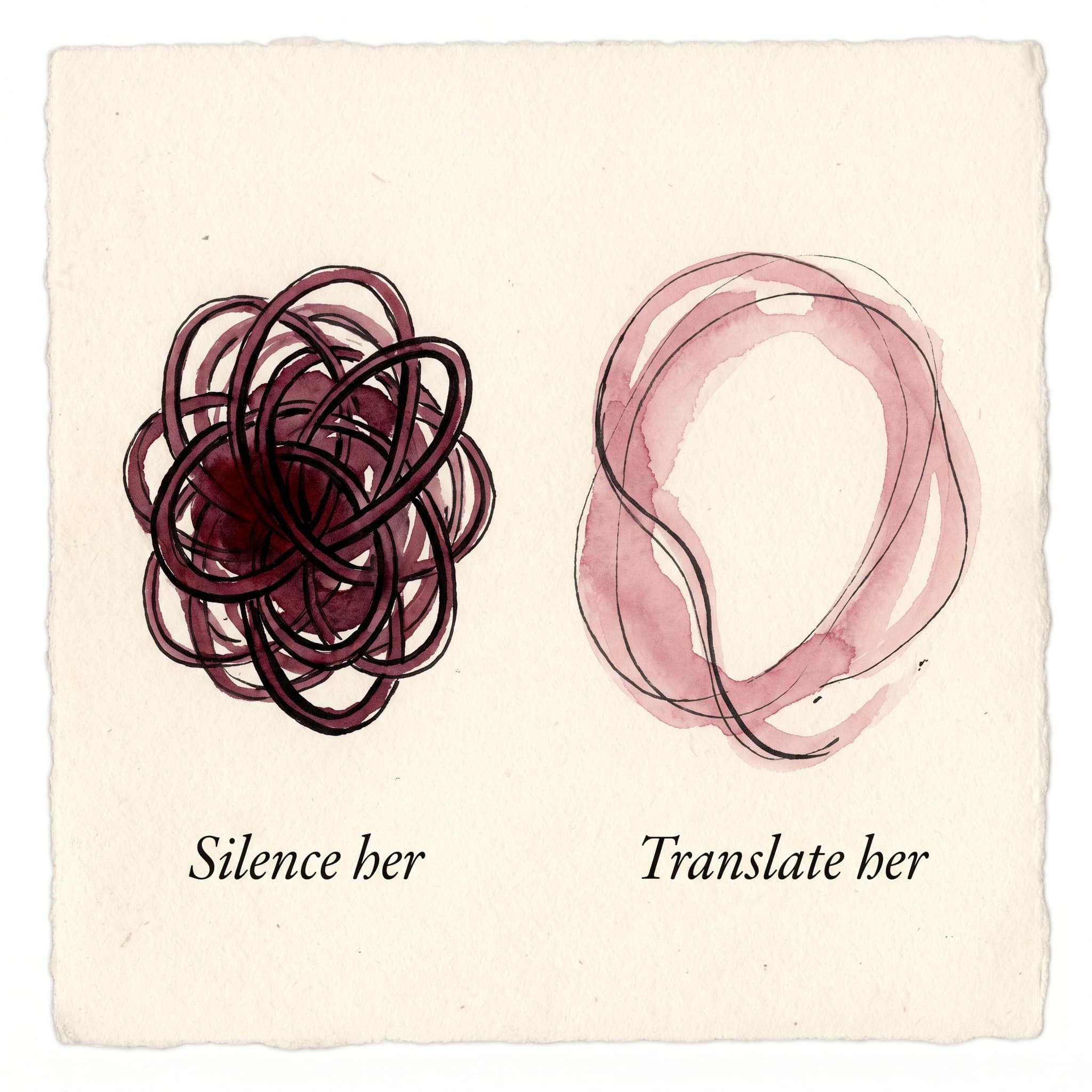
The combined effect of these three moves is what we mean, throughout HerDay, by translation. The critic still arrives. She is still the first voice you hear. The second voice — second-person, conditional, warm — does not argue with her. It simply restates the underlying concern in a register the soothing system can act on.
The fear underneath: if I'm kind to her, I'll lose my edge
This is, in our reader research and in the published literature, the most common objection. It is also the one most clearly answered by data.
In her 2011 paper, Neff showed that self-compassion was associated with higher, not lower, personal standards.Neff 2011 Self-compassionate participants set ambitious goals at the same rate as self-critical participants — but they recovered from failure faster, attempted more difficult tasks afterward, and reported lower levels of fear of failure across multiple replications.
Subsequent work with elite athletes (Mosewich, Crocker, Kowalski) found the same pattern: self-compassion was correlated with greater perseverance, not reduced ambition, and with lower rumination after performance setbacks.Mosewich 2013 The mechanism Neff and colleagues propose is straightforward: self-criticism does not motivate sustained effort; it motivates avoidance of the situation in which the criticism keeps occurring. Replacing the critic with a kinder voice does not reduce drive. It reduces the cost of trying again.
If you have built a career on a loud critic, this is genuinely uncomfortable to hear, because part of you suspects she is the reason for the career. The research is reasonably clear that she is not. She is the reason for the exhaustion next to the career.
The critic was never your edge. She was the tax you paid for not yet having a kinder voice loud enough to replace her.
What to do tomorrow morning that isn't silence her
The full clinical protocols — MSC, CFT, IFS — take eight to twelve weeks under a trained therapist and are recommended where the inner critic is severe enough to be debilitating. What follows is the much smaller, evidence-aligned, one-minute morning version. None of it replaces therapy. All of it is consistent with what the underlying research suggests is durable.
- Hear her without arguing. When the first critical sentence arrives, do not contradict it. Note it, the way you would note the weather. Ah — that voice again. The one that thinks I should already know this.
- Name what she is protecting you from. Almost always, the answer is one of three: rejection, failure, or being seen and judged. Naming the underlying concern in plain language — you're worried I'll be embarrassed — disarms the threat system more than disputing the surface claim ever does.
- Address yourself by name in the second person, in conditional language. Maddie, you are learning to do this without being cruel about it. That is enough for today. This is Kross-style self-distancing combined with Wood-style conditional framing. The combination is more durable than either alone.
- Let the critic remain in the room. Do not try to make her leave. The goal is not her absence. The goal is that her voice is no longer the loudest one you hear.
Done for sixty seconds, before any app, before any screen, before any conversation, this is the minimum effective dose. Done daily, the research suggests, it produces the shift Neff's MSC trials produce: lower self-judgment, faster recovery from setbacks, the same standards, less of the fatigue.
The reason we built HerDay around voice is that this practice is harder than it sounds when the only voice in the room at 5:47 a.m. is the critic's. Hearing the translating voice in your voice — addressed by name, conditional, steady — collapses the distance between hearing it and believing it is yours. The critic is still there. She just speaks second now.

Do affirmations actually work? A 2026 evidence-based review
Affirmations work — but only the kind grounded in your existing values, and only when phrased to match where your self-esteem actually is. Here is what 30 years of psychology research shows, and where most apps get it wrong.
Why your own voice works better — the quiet psychology of hearing yourself
Hearing your own voice changes how a self-statement lands. Not because it's louder — because the brain processes self-voice as identity-relevant data. Here's what 30 years of research on future-self continuity, self-distancing, and voice recognition actually shows.
The inner-critic translation technique — a 4-step method to turn self-attack into usable information
Your inner critic is loud, fast, and almost always trying to tell you something underneath the cruelty. This is a 4-step technique — grounded in self-compassion, self-distancing, and conditional-language research — for translating what she says into something you can actually use, without silencing her or believing her.