Do affirmations actually work? A 2026 evidence-based review
Affirmations work — but only the kind grounded in your existing values, and only when phrased to match where your self-esteem actually is. Here is what 30 years of psychology research shows, and where most apps get it wrong.


Affirmations work — but only the kind grounded in your existing values, phrased to match where your self-esteem actually is, and repeated long enough for the brain to treat them as identity-relevant data. Thirty years of research, from Claude Steele's 1988 self-affirmation theory to Joanne Wood's 2009 paradox, points to the same conclusion: generic positive self-statements often misfire, while value-tied or conditional ones change measurable behavior.
The interesting question is no longer whether affirmations work. It is which kind, for whom, how, and with what evidence. Here is the honest review.
A short self-statement designed to reinforce a value, identity, or attitude. In research contexts (Steele 1988 onward), the active ingredient is not positivity but self-relevance — the affirmation has to touch something the person already holds as core. Pop usage often inverts this, treating affirmations as motivational claims to make true through repetition; the evidence does not support that model.
What the research actually says
Self-affirmation theory begins with a deceptively simple finding. Claude Steele, working at Stanford in the 1980s, was trying to understand why people defend themselves against threatening information — health warnings, criticism, evidence they had done something wrong. He found that if you asked people to first write about a value they held — family, faith, growth, fairness — they became measurably less defensive when the threat was introduced.Steele 1988 Their grades changed. Their willingness to consider hard medical information improved. Their cortisol response to social stress declined.Cohen et al. 2003
What is striking about Steele's finding is what didn't matter. The value didn't have to be related to the threat. Writing about your love for your sister buffered you against an exam result. Writing about your faith buffered you against medical news. The mechanism was not "use the affirmation to argue with the threat." It was "remind the brain that the self is bigger than this one domain."
This is the version of affirmations that has held up under three decades of replication. It is also almost entirely unlike the version most apps sell you.
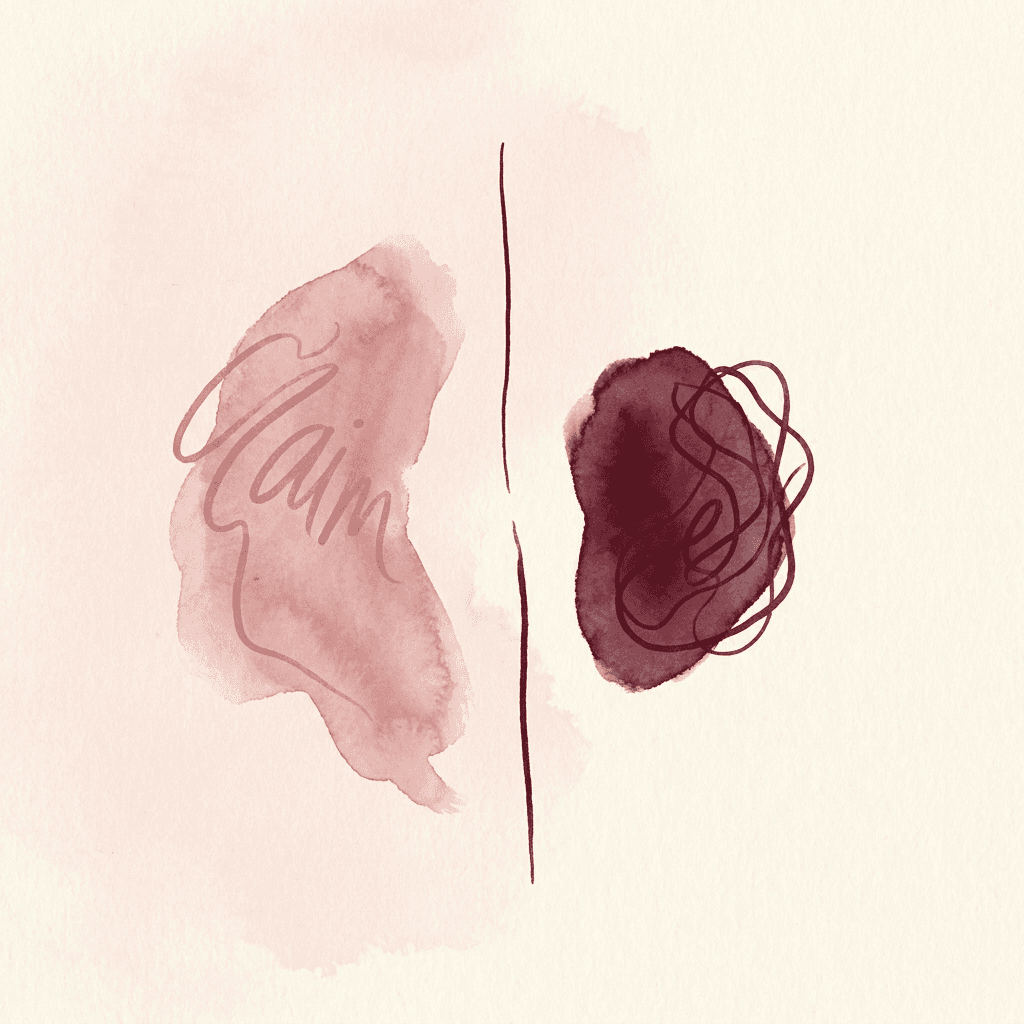
The other foundational finding — and the one that should keep app designers honest — is Joanne Wood's 2009 paper, Positive Self-Statements: Power for Some, Peril for Others.Wood et al. 2009 Wood and colleagues at the University of Waterloo asked two groups — one with high self-esteem, one with low — to repeat the statement "I am a lovable person." The high-self-esteem group reported a small mood improvement. The low-self-esteem group reported worse mood than a control group that hadn't repeated anything at all.
Wood's interpretation: when the brain holds a self-concept (I am not lovable) and is asked to repeat a directly contradicting statement, it does not resolve the gap by updating the concept. It resolves it by deepening rumination on the evidence the concept is based on. "I am a lovable person" becomes, in the inner ear, "…then why hasn't anyone…"
Most affirmation apps were built without reading this paper. It is the single most-replicated complication in the literature, and it is the reason your friend with high self-esteem swears by affirmations while your friend with the cruel inner voice swears they made her worse.
The four findings I would build my morning around
If I were designing my own affirmation practice from scratch, with no app and no marketing, I would build it around four findings. They are the ones that have held up across replication, fMRI, and field experiments.
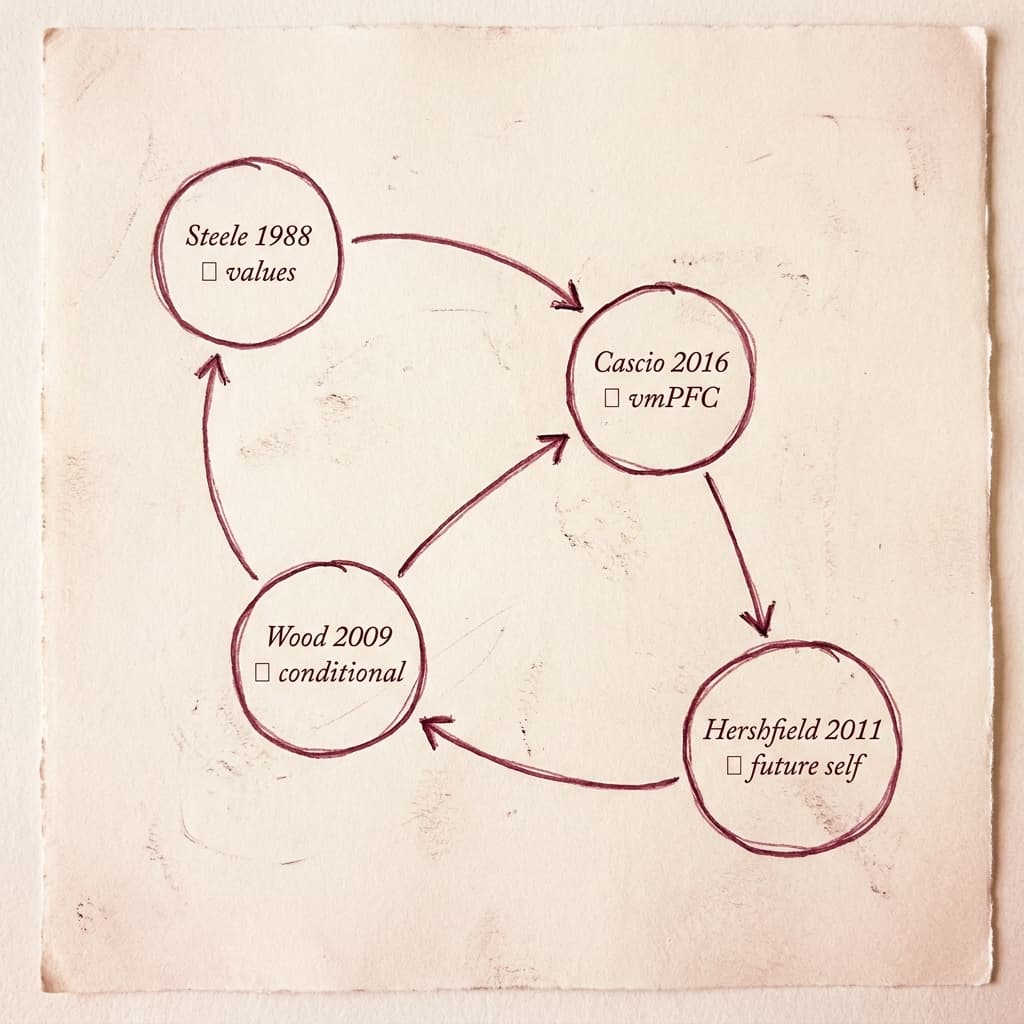
Steele 1988. Use values, not adjectives. "I am a person who shows up for my friends" lands better than "I am loved" — not because the second is wrong, but because the first is a value claim and the second is an outcome claim. The brain will defend the value. It will catch the outcome.
Wood 2009. Match phrasing to current self-view. If your inner critic is loud, declarative claims will trigger her. Conditional language gives the brain a direction of travel it can accept. "I am learning to," "I am becoming," "Some part of me already," "I am the kind of person who is starting to." Two-thirds of HerDay's morning copy is conditional by default for exactly this reason.
Cascio 2016. When affirmations work, the activation is measurable. Cascio and colleagues used fMRI to show that affirming a core value lights up the ventromedial prefrontal cortex (vmPFC) and the ventral striatum — areas associated with self-evaluation and reward.Cascio et al. 2016 The effect was stronger when the affirmation was about the self and processed as personally relevant. This is not the marketing version of "neuroscience says affirmations work." It is a narrower, better-supported version: affirmations engage specific self-referential and reward networks when they are personally relevant.
Hershfield 2011. Connect the present self to the future one. In a study published in the Journal of Marketing Research, participants shown an age-progressed image of themselves allocated 30% more to a retirement account.Hershfield et al. 2011 The mechanism — future-self continuity — is that humans tend to treat their future selves as strangers, and we save less for strangers. An affirmation that addresses the listener as her future self ("Maddie, the year you're walking toward already knows you can…") engages this lever. We wrote about why audio in your own voice deepens this effect — the short version is that hearing yourself from a year ahead is the strongest known consumer-grade version of Hershfield's intervention.
The brain will defend a value. It will catch an outcome claim. Most apps sell you outcome claims.
Where most apps get it wrong
Three patterns recur across the affirmation-app category, and each one is the consequence of building product without reading the literature.
1. Generic libraries by category. An app that hands you 1,000 affirmations sorted by Career, Love, Confidence, and Health has built a search engine, not a ritual. Steele's finding is that the active ingredient is your values touching your affirmation. A library you pick from is the right shape only if you also know which value your week is short on. Most users don't and shouldn't have to.
2. Declarative by default. "I am loved." "I am enough." "I am abundant." These are fine for high-self-esteem users. They are quietly harmful for low-self-esteem users, per Wood (2009). An app that defaults to declarative phrasing and lets the high-self-esteem half of its user base evangelize it is selling something that is documented to make a non-trivial percentage of its audience feel worse.
3. Strangers' voices. A recorded actor reading affirmations is pleasant. The brain processes it as social input — somebody else's voice, somebody else's claim. The Hershfield lever — addressing the listener as her future self in a self-recognizable voice — is sitting unused. Voice cloning and value-tied generation finally make this lever cheap enough to build, and we expect this to be the next category-defining shift in the space.
When the evidence is genuinely mixed
I want to flag two places the research is less settled than affirmation enthusiasts pretend.
Long-term behavior change. The cleanest findings (Steele 1988, Cohen 2003) are about acute effects — defensiveness in a specific moment, stress response in a specific test. The evidence that a daily affirmation practice changes core self-concept over months is thinner, and what exists is mostly correlational. We have strong evidence that affirmations work in the moment. We have weaker evidence that doing them every morning for a year fundamentally reshapes who you are. Both can be true, but the second claim is more often asserted than demonstrated.
Self-talk for clinical depression. Affirmations are not a treatment for major depressive disorder. They are not a substitute for therapy or medication where those are indicated. If you are in active depression, the Wood (2009) finding suggests that some affirmation phrasings can make rumination worse, not better. Speak to a therapist. The morning ritual lives alongside clinical care, not in place of it.
Manifestation as a whole. Practices labeled manifestation in the modern usage (369 method, scripting, law of assumption) overlap with the affirmation literature in component techniques (visualization, intention-setting, identity claims) but rest on a wider belief system about cognition shaping external reality. The component techniques have evidence. The wider belief system does not, in the form it's usually presented.

So — do affirmations actually work?
Yes, with three qualifications.
They work when they touch a core value you already hold. They work when phrased to match where your self-esteem actually is — declarative if you can carry it, conditional if you can't yet. They work in the acute case (today's stress, today's threat) better than they work as a slow rewrite of identity, though both effects are real and the second compounds over time.
They do not work as motivational claims you repeat into truth. The brain is too good at catching the gap. If you tried "I am a lovable person" and felt worse, the literature is not surprised by that. You did not fail. The phrasing did.
If you want a working version of an affirmation practice, build it on values you hold and phrase it in language your inner critic cannot dismiss. Address yourself by name. Use second person where it helps. If you can hear it instead of read it, do that; if you can hear it in your own voice from a year ahead, do that. The research supports each of these moves individually. The practice that combines them is the practice we built HerDay around.
Why your own voice works better — the quiet psychology of hearing yourself
Hearing your own voice changes how a self-statement lands. Not because it's louder — because the brain processes self-voice as identity-relevant data. Here's what 30 years of research on future-self continuity, self-distancing, and voice recognition actually shows.
Letter to your future self — how to write one, and why it changes more than you'd think
A letter to your future self is a small, well-studied intervention with measurable effects on saving, self-care, and follow-through. Here is the research behind it, a 7-step method to write yours in 30 minutes, 12 prompts to start, and one common mistake that quietly undermines the whole point.
Your inner critic isn't telling the truth — she's reading old data
The inner critic feels like a verdict. The research says she's a reflex — a learned, protective voice repeating old data with high confidence. Here's what Neff, Gilbert, and Kross actually found, and what to do with her tomorrow morning that isn't 'silence her.'