Letter to your future self — how to write one, and why it changes more than you'd think
A letter to your future self is a small, well-studied intervention with measurable effects on saving, self-care, and follow-through. Here is the research behind it, a 7-step method to write yours in 30 minutes, 12 prompts to start, and one common mistake that quietly undermines the whole point.

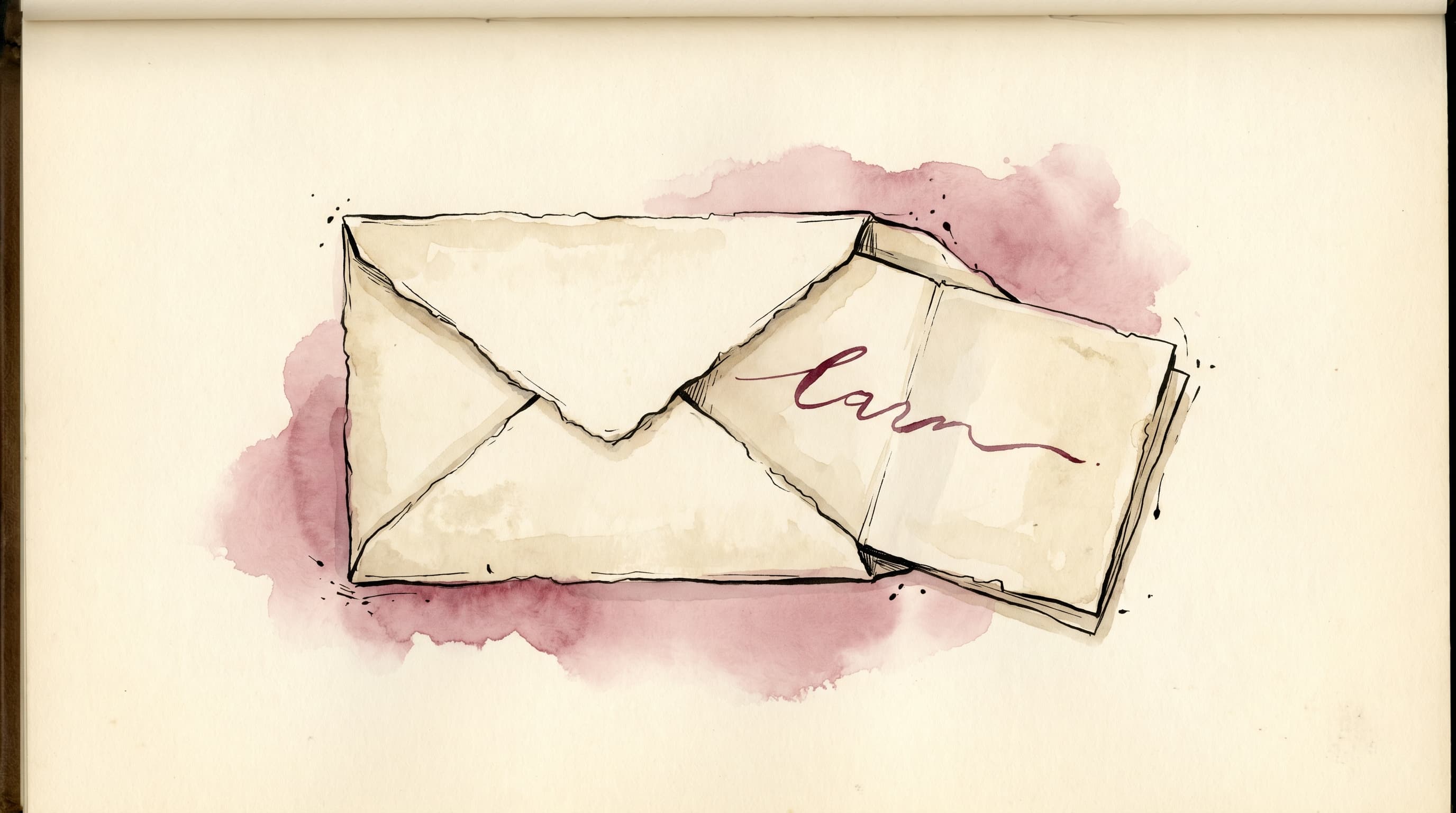
There is a small ritual that keeps showing up in the psychology research — older than the apps that have started selling it, smaller than the manifestation-industry version, and quieter than most of the language used to describe it. You sit down for thirty minutes. You write a letter to a version of yourself who will exist in one to three years. You seal it. You schedule it to arrive on a specific day. Then you forget about it, and let the time do what time does. Months later, the letter arrives, and a quiet thing happens that the studies have been pointing at for fifteen years. Here is what the research actually shows, how to write yours in seven steps without it becoming a list of goals, twelve prompts to start with, and the one common mistake that drains the practice of most of its effect.
A written address from your present self to a version of you in a defined future time window (typically six months to three years), phrased as a direct second-person letter, sealed at the time of writing, and delivered on a specific date you choose. The practice engages the future-self continuity mechanism described in Hershfield (2009, 2011) — the degree to which the brain treats your future self as the same person rather than as a stranger.
What a letter to your future self actually is — and isn't
The first thing worth clearing out of the way is what this practice is not. It is not a manifestation script. It is not a vision board in paragraph form. It is not a list of goals you'd like the universe to deliver, or a contract you're trying to bind your future self to. Each of those is its own thing, with its own (much weaker) evidence base, and the marketing-blur between them is part of why the underlying practice gets dismissed.
A letter to your future self is closer to a time-displaced conversation. You are addressing a real person — yourself, in twelve or eighteen or thirty-six months — who will read the letter from inside a life you cannot see yet. The letter is not about telling her what to do. It is about giving her something that is hard to give yourself in the future: an honest record of who you were right now, why it mattered, and what you were quietly hoping for on her behalf.
The mechanism the practice engages is well-named in the psychology literature. Hal Hershfield at UCLA has spent more than a decade studying future-self continuity — the degree to which a person experiences their future self as the same person, rather than as a stranger they happen to share a body with.Hershfield 2009 When future-self continuity is high, people save more, exercise more, take fewer destructive shortcuts on her behalf. When it is low, the future self is treated, behaviorally, the way most people treat a stranger asking them for money. Hershfield's lab has shown this in the lab, in the field, and in actual retirement-account allocation data.
A letter, written from present-you to future-her, is one of the simplest interventions on this mechanism that exists. You don't need a VR headset, a financial advisor, or a personalized AI. You need a piece of paper, twenty minutes, and the willingness to be slightly more honest than is comfortable.

Why this small ritual changes more than you'd think
The skepticism worth taking seriously, before we go further, is this: most rituals don't change anything measurable. Why would a letter? The answer is in three separate findings, each of which on its own would be unremarkable. Stacked, they produce most of the effect.
1. The future self is treated more like a stranger than people realize. In Hershfield's 2009 work, fMRI scans showed that, when participants thought about their current selves, the medial prefrontal cortex (mPFC) — a region associated with self-referential processing — lit up the way it always does. When the same participants thought about themselves in ten years, the mPFC activation pattern was closer to the one they showed when thinking about another person than to the one for themselves. The future self is, neurologically, often filed under someone else. Behaviour follows accordingly: we save less for her, exercise less for her, postpone difficulty onto her shoulders.Hershfield 2009
2. Addressing yourself in the second person measurably regulates emotion. Ethan Kross's lab has shown across more than a decade of studies that switching from I to you when reflecting on difficulty reduces amygdala activation, lowers anxiety, and produces more constructive plans of action.Kross et al. 2014 A letter is, by definition, a second-person address. It bakes Kross's self-distancing finding into the form of the practice without you having to think about it.
3. Expressive writing, on its own, produces durable effects. James Pennebaker's expressive-writing paradigm — twenty minutes of honest writing about something emotionally significant — has been studied for forty years and replicated across thousands of participants. The findings consistently show modest but real reductions in stress markers, fewer doctor visits over the following months, and improved working memory.Pennebaker 1997 The writing matters even when no one ever reads it.
Stack the three. You are doing future-self continuity work, with second-person self-distancing built in, expressed in the form of expressive writing. None of them is dramatic on its own. Together, they explain why a small practice keeps showing up across separate research traditions with quiet, consistent effects.
The most common mistake — and why it quietly undoes the practice
There is one mistake that drains most of the research effect out of the practice, and it is almost universal in the first letter people write. You make your letter a list of goals.
Dear future self, the letter begins. By the time you read this, you will have run a half-marathon. You will have left the job. You will have saved twelve thousand euros. You will…
This is not a letter. It is a contract you are trying to slip past your future self without her noticing. It triggers, in her, exactly the resistance any contract triggers — who said I agreed to this? — and it tells the part of her psychology that the letter was supposed to engage that you are still treating her as a stranger you can issue instructions to.
The research on what makes future-self interventions work is consistent on this point. The mechanism activates when the future self feels seen, named, and continuous with the present self — not when she is handed a checklist by a previous version of herself who is no longer around to defend it. The letters that move things are not the goal-list letters. They are the letters that read like one friend writing to another, separated by time.
The seven-step method
What follows is the version refined across the letters we read while building HerDay's Future Self Letter tool. It is short on purpose. You do not need a workshop or a journaling practice or a therapist. You need thirty minutes, a piece of paper, and the willingness to be one degree more honest than is comfortable.
Step 1 — Date both ends of the letter. Today's date at the top. The intended delivery date in the salutation: Dear me on October 14, 2027. Naming the date pulls her out of abstraction. She becomes a person on a Wednesday, not a fictional future character.
Step 2 — Greet her by the name you actually use. Not your full legal name. The name the people who love you call you. Maddie, not Madeline Rose Pereira. The brain files audio and text under the name it recognizes — using the casual name is a small Kross-style self-distancing cue that doubles as a recognition signal.
Step 3 — Locate the moment honestly, in three sentences. Where you actually are this week. Not the curated version. I'm writing this in a kitchen at 11 p.m., the dog is asleep, the work thing is harder than I admitted in the family group chat, and the apartment has been a little too quiet for a while now. Three sentences. The honesty is the load-bearing part.
Step 4 — Name what matters to you right now, in your own words. Not goals. Values. Not finish the book, but I want to keep being someone who finishes what she starts, even when it stops being a story I can tell on Instagram. Values, named honestly, are what survive twelve months of new circumstances. Goals don't.
Step 5 — Address her directly, in the second person. Not I will be. You are. Not I hope I. I hope you. The second person is the engine. It engages the same self-distancing mechanism Kross's work documents. You are still the person who, on the night of writing this, decided to send the difficult email. Whatever happened next, you decided.
Step 6 — Phrase your wishes for her as questions, not as demands. Demands trigger resistance. Questions invite. Are you still finding ways to be quiet on Sundays? lands differently than You will rest on Sundays from now on. Questions also have the unexpected effect of making the letter feel like an actual letter when she reads it, rather than a recovered to-do list.
Step 7 — Sign and seal. Sign with the same name you greeted her by. Note the date again. Schedule the delivery (paper in a sealed envelope with a date on the front; or a service like our Future Self Letter that handles the timing). Then close the file. The closing matters. The letter only works as a letter if, between writing and reading, it has time to become something you've forgotten you wrote.
Twelve prompts that have produced good letters
If you sit down to write and the page stays blank — which happens almost universally on the first try — start from one of the following. Pick the one you flinch at slightly. The flinch is information.
- What is one thing you are protecting, right now, that nobody else can see?
- Who has been quietly important to you this season, and have you told them?
- What part of who you are today is not yet legible to the people around you?
- What did you finally stop arguing with yourself about, in the last six months?
- What are you still negotiating with that you secretly hope is done by the time she reads this?
- What is the version of restless you have been mistaking for ambition lately?
- Is there anyone you have been kinder to than you have been to yourself?
- What does enough actually look like, if you stop adjusting the definition?
- What do you want her to remember about your apartment / room / morning at this exact moment?
- What's the smallest decision this month that you would like her to be glad you made?
- What's a fear you'd like her to no longer recognize?
- If she is reading this on a hard day, what's the one true sentence you would want her to land on?
The twelfth prompt is the one we recommend you do not skip, even if the rest of the letter is built around something else. A letter that closes with a single true sentence — one she will read on the day she opens it, whatever shape that day is in — is the letter that earns its place in the drawer.
How long, how often, what to do with it afterwards
A few practical questions that come up almost every time someone sits down to do this.
Length. One page, single-sided, by hand if you can. Anything past one page tends to slide into the goal-list mode the practice fails in. The constraint is the discipline.
Frequency. Once a year is the rhythm that works for most people, with the delivery date at twelve to eighteen months. Some people write a second, shorter letter on their birthday addressed to the next birthday. More than that and the letters start to feel like a chore rather than a quiet ritual.
Delivery. Paper in a drawer with a delivery date on the envelope works fine. A scheduled email also works. The only constraint is that the delivery date has to be far enough out that you forget the specifics of what you wrote. If you can still recite the letter from memory, it hasn't done its work yet.
Reading it. Read it once, slowly, on the day it arrives. Don't reply in your head. Don't immediately write the next one. Sit with it for the day. The letter is a piece of input, not a thread. Some of what's in it will still be true. Some of it won't. The gap between the two is the data the practice gives you for free.
You aren't writing to your future self because she will need a list of instructions. You are writing because she will need evidence that the person who lived this version of your life was paying attention.
What the letter cannot do
It is worth saying clearly. A letter to your future self does not change the next twelve months on its own. It is not a manifestation device. It will not, on its own, get you the job, the relationship, the body, the apartment, the savings figure you are quietly hoping for.
What it does is small and well-documented. It increases the chance that the future-you will treat present-you as a real person rather than as a stranger. It compresses the future-self distance Hershfield's work measures. It engages the self-distancing mechanism Kross's lab has spent fifteen years documenting. And it produces, on the day of arrival, a moment of contact between two versions of the same person that is otherwise almost impossible to engineer.
That is what the research supports. Anything more is marketing. Anything less misses what is, on the evidence, one of the most under-used and quietly useful self-talk practices in the literature.
Why your own voice works better — the quiet psychology of hearing yourself
Hearing your own voice changes how a self-statement lands. Not because it's louder — because the brain processes self-voice as identity-relevant data. Here's what 30 years of research on future-self continuity, self-distancing, and voice recognition actually shows.
Voice cloning for affirmations, explained — what's actually happening inside the model
A 60-second sample of your voice is enough for a modern model to render new sentences in your acoustic signature. Here's what voice cloning actually does, why it matters specifically for affirmations, and how we built it inside HerDay so the model never leaves your device.
Do affirmations actually work? A 2026 evidence-based review
Affirmations work — but only the kind grounded in your existing values, and only when phrased to match where your self-esteem actually is. Here is what 30 years of psychology research shows, and where most apps get it wrong.