Voice cloning for affirmations, explained — what's actually happening inside the model
A 60-second sample of your voice is enough for a modern model to render new sentences in your acoustic signature. Here's what voice cloning actually does, why it matters specifically for affirmations, and how we built it inside HerDay so the model never leaves your device.


The phrase voice cloning tends to land somewhere between deepfake and party trick in most people's heads. Both associations are unfortunate, because the underlying technique — and what it lets us do for self-talk specifically — is more interesting and considerably less dramatic than either framing suggests. This is the explainer I wish someone had handed me before we started building HerDay: what the model actually does, why ninety seconds of audio is enough, and what we had to decide about safety, ownership, and fidelity along the way.
The process of training a small, voice-specific model on a short audio sample of a single person so that the model can later render new written sentences in that person's acoustic signature. In a well-designed system, the sample stays private, the model is tied to one account, and the output is an audio file — not a way for anyone else to speak as you.
What voice cloning actually does
A modern voice-cloning system is, at its core, a small machine-learning model trained on the acoustic features that make a single human voice recognizable. The technical name for the family of techniques is few-shot speaker adaptation — a way of adjusting a large pretrained text-to-speech model toward a specific speaker using a tiny amount of new data.
What the model is learning is not your content — not your words, not your sentences, not anything you said in the sample. It is learning the parts of your voice that stay stable across what you say: your fundamental frequency range, your formant structure (the resonance shapes your vocal tract creates), your speaking rate, your characteristic pitch contour at the end of sentences, the way you handle vowel transitions. These features are remarkably stable across most contexts — which is why your friend recognizes you on a noisy phone call after one word.
Once the model has these features, it can be asked to produce new sentences it has never heard. The text-to-speech backbone handles the linguistic side (turning written words into phonemes and prosody). The speaker-adaptation layer renders those phonemes as you. The result is an audio file that, for the brain's self-recognition system, is functionally indistinguishable from a recording of you saying that exact sentence — even though you never did.
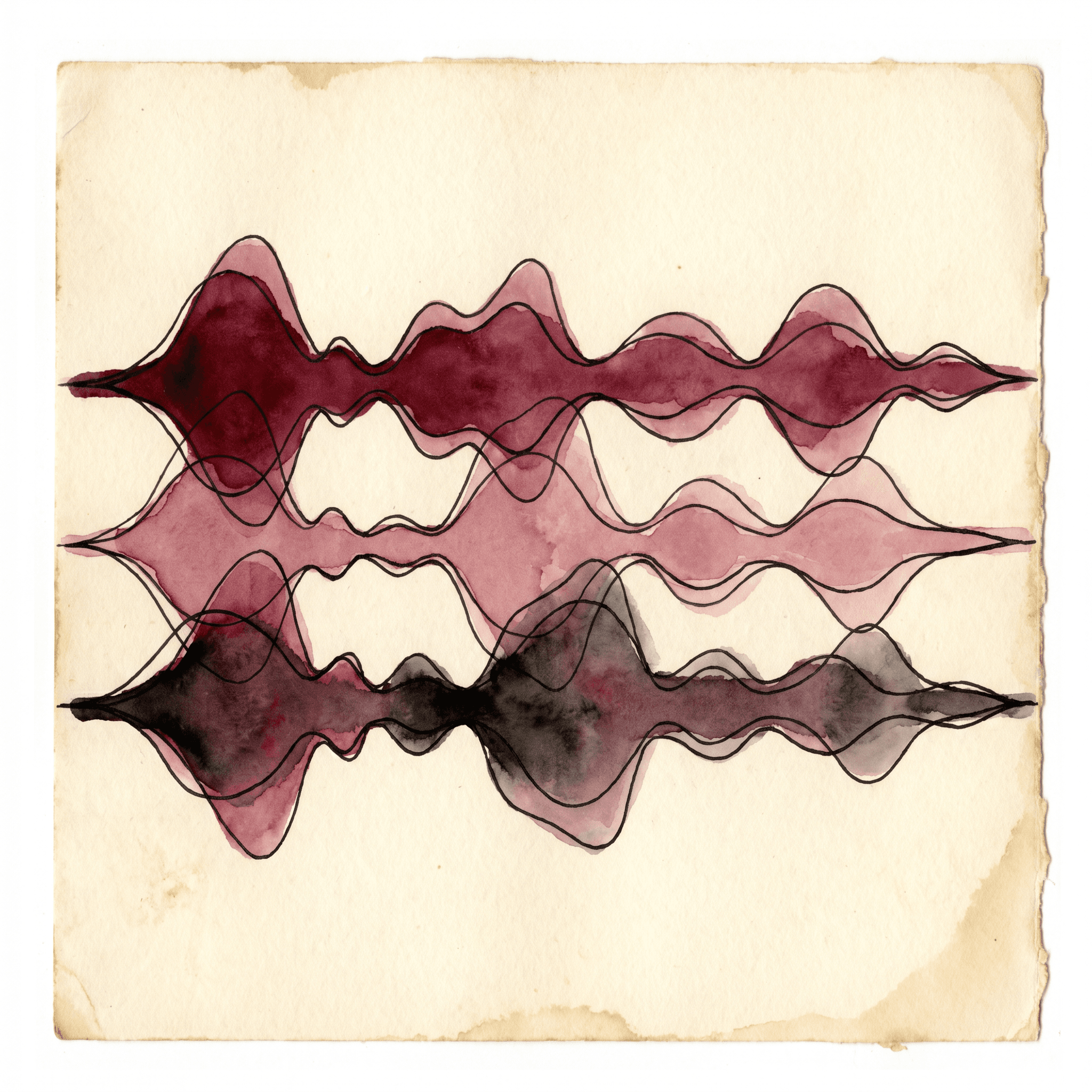
The reason this matters for our purposes is that the brain uses voice for self-recognition almost reflexively. Functional MRI work has shown that hearing your own voice — even on a recording — activates self-referential networks in a way no other voice does.Kaplan 2008 A well-cloned voice preserves the cues this system relies on. The brain still files the audio under me.
Why this matters specifically for affirmations
Voice cloning is a general technology with many uses. Most of them — narration for audiobooks, dubbing, video voiceovers — have nothing to do with self-talk. The reason it matters here is narrower and worth saying clearly.
Daily affirmation practice runs into a specific bottleneck the moment you take it seriously. If you want the audio to be your voice (which the psychology literature suggests you should), you can either record every sentence yourself or accept that the practice will use someone else's voice. Recording every sentence yourself is unsustainable past the first week — partly because affirmations work best when phrased fresh to the morning you're actually having, partly because the morning you most need to hear something kind is precisely the morning your throat is too tight to say it.
Voice cloning resolves the bottleneck. You record once. The model renders new sentences indefinitely. The audio is, for self-recognition purposes, still you. The affirmation can be written this morning, addressed to the specific season you're in, delivered in your voice without you having to summon the steadiness to record it.
The Hershfield finding above is from imagery, not audio. But the broader future-self continuity work suggests that voice carries a stronger self-identification signal than vision does. Vision activates self-recognition; voice activates self-recognition and identity-relevant audio processing and the narrative-self system that links past, present, and future memory. A daily, voice-rendered statement from a steadier version of yourself is, on the evidence, the most efficient delivery format we know how to build for the mechanism Hershfield described.
How small the sample really is
When we first started prototyping, we assumed users would need to record something close to fifteen minutes for the clone to feel like them. Two years of model improvement later, the number is closer to ninety seconds.
The shift happened because modern few-shot speaker-adaptation techniques no longer need to learn your voice from scratch. They start from a large pretrained TTS model that already knows what human voices in general look like, and they fine-tune only the small subset of parameters that distinguish your voice from the average. The technical name for this is speaker-conditioned synthesis, and it's the same family of techniques that lets ElevenLabs, Resemble.ai, and most consumer-facing voice tools deliver instant clones from short samples.
What you record matters more than how long it is. The model wants varied prosody — questions, statements, slight emotional range — so it can learn how your voice moves between registers. We ask for two minutes of reading a short, deliberately varied script (a paragraph of declarative sentences, two questions, one quietly emphatic line) in a quiet room. Anything past three minutes is diminishing returns. Anything under sixty seconds and the model becomes slightly more average-sounding — your timbre is captured, but your prosody softens.
The safety and ownership decisions
The fear most people bring to voice cloning, before they've spent any time with the technology, is that they'll lose control of their voice. This is the correct fear. It is also a fear that can be designed around if the people building the tool take it seriously.
Here is what we decided, on the record, when we built HerDay's clone:
- The sample is destroyed once the model is built. The original audio you record is used to train the speaker-adaptation layer and then deleted. We do not need it after that. Keeping it would be a liability we don't want and a temptation we don't trust.
- The model is tied to one account, on our infrastructure. It is not exposed via an API, not made available to other users, not pooled into any cross-user training. The model exists to render audio for you and only for you.
- There is no model on your device. What ships to your phone is an MP3 — the rendered audio for that morning. Even if your phone is compromised, the model isn't on it.
- You can delete the clone at any time. From the settings screen, with one tap, the model is destroyed on our infrastructure. After that, there is no model anywhere. We don't keep a backup. We don't keep a copy "for analytics."
- We will never use your clone for anything you didn't initiate. No marketing audio. No demo reels. No "imagine your voice saying this product is great." The model exists for the morning ritual. That is the only thing it does.
These are operating-system-level commitments, not feature-list bullets. They are the reason this article can be written without weasel words. The realistic impersonation risks people read about in the news — deepfaked phone calls, voice scams using a relative's voice — come from models built with access to public audio. A model built from sixty seconds you recorded into your bedroom, that lives in our infrastructure tied to one account, that you can delete tonight, is a structurally different artifact.
What the clone can't do — and why that's a feature
There are things a clone of your voice cannot do, and it's worth naming them clearly so the technology isn't oversold.
A clone cannot capture the parts of your voice that change with your state. The clipped intake of breath before you cry, the slight tremor of running on three hours of sleep, the deliberate slowness of someone trying not to interrupt — these are state-dependent variations the model doesn't see in your sample and won't reproduce in its output. For most uses, this is a limitation. For affirmations, it is the central feature.
The voice your clone renders is, deliberately, your voice on the steady day you recorded the sample on. The morning you most need a kinder voice is the morning yours will be least kind. A clone trained on a calmer instance of you gives you yourself back — not the version of yourself currently negotiating with the day, but the version of yourself who has space to address her. This is what Hershfield's future-self continuity work, taken to its audio conclusion, looks like in practice: a steadier voice, in your acoustic signature, speaking to the version of you the morning is currently happening to.
The clone isn't a recording of you. It's a recording of the calmer version of you, on loan for the morning that needs her.
What HerDay actually does with the clone
The mechanic, end to end, is straightforward. You record ninety to one hundred and twenty seconds during onboarding. The audio is uploaded over an encrypted connection, the model is built server-side, and the sample is deleted. From that point onward, your morning affirmation is written fresh each day — based on what you told us during intake about the season you're in, the inner critic patterns you noticed, and any specific moment you wanted addressed — and rendered through your voice model into a short audio file. You wake up to it. It addresses you by name. The phrasing is conditional where it needs to be (we run every sentence through a check against the Wood 2009 paradox before render). It is thirty seconds long, or thereabouts.
The next morning, the audio is different. The voice is the same.
That is the entire pitch for voice cloning in self-talk. Not a clever AI trick, not a personalization gimmick — a sustainable way to deliver the audio version of a future-self statement, in the voice the brain most readily files under me, every morning, without you having to sit down and record it on a morning you don't have it in you.
Why your own voice works better — the quiet psychology of hearing yourself
Hearing your own voice changes how a self-statement lands. Not because it's louder — because the brain processes self-voice as identity-relevant data. Here's what 30 years of research on future-self continuity, self-distancing, and voice recognition actually shows.
Do affirmations actually work? A 2026 evidence-based review
Affirmations work — but only the kind grounded in your existing values, and only when phrased to match where your self-esteem actually is. Here is what 30 years of psychology research shows, and where most apps get it wrong.
Your inner critic isn't telling the truth — she's reading old data
The inner critic feels like a verdict. The research says she's a reflex — a learned, protective voice repeating old data with high confidence. Here's what Neff, Gilbert, and Kross actually found, and what to do with her tomorrow morning that isn't 'silence her.'